What is the most expensive car in the world? The 1931 Bugatti Royale Kellner Coupe was sold for $8,700,000 in 1987. However, that car and many alike will not be included in this list because it is not available on the market today. It is hard to imagine someone would actually spend 8 million dollars on a car instead of using it for something more productive. However, if you have the money and the opportunity, you will definitely spend a small fraction of it to place a few of these supercars in your garage. Here are the 10 most expensive production cars on the market.
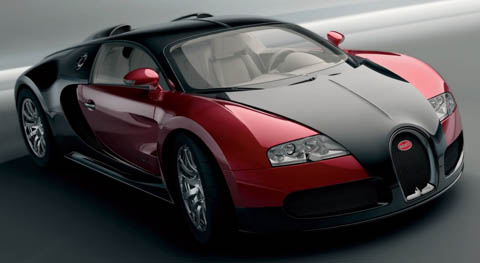
1. Bugatti Veyron $1,700,000. This is by far the most expensive street legal car available on the market today. It is the fastest accelerating car reaching 0-60 in 2.6 seconds. It claims to be the fastest car with a top speed of 253 mph+. However, the title for the fastest car goes to the SSC Ultimate Aero which exceed 253 mph pushing this car to 2nd place for the fastest car.
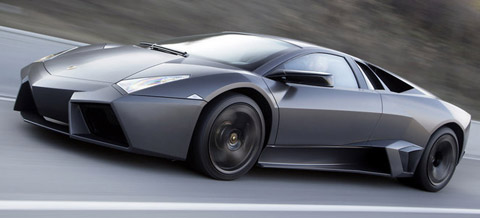
2. Lamborghini Reventon $1,600,000. The most powerful and the most expensive Lamborghini ever built is the second on the list. It takes 3.3 seconds to reach 60 mph and it has a top speed of 211 mph. Its rarity (limited to 20) and slick design are the reasons why it is so expensive and costly to own.
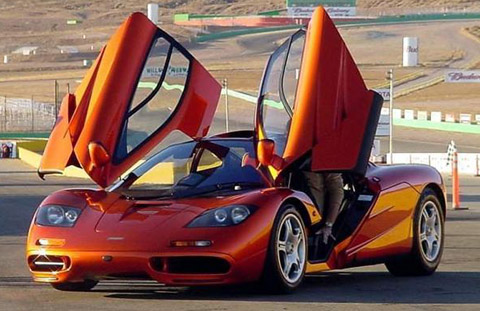
3. McLaren F1 $970,000. In 1994, the McLaren F1 was the fastest and most expensive car. Even though it was built 15 years ago, it has an unbelievable top speed of 240 mph and reaching 60 mph in 3.2 seconds. Even as of today, the McLaren F1 is still top on the list and it outperformed many other supercars.
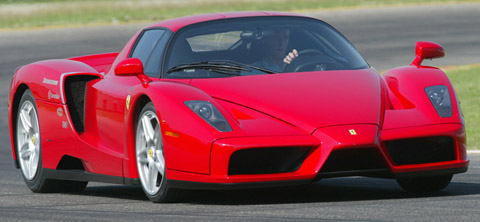
4.Ferrari Enzo $670,000. The most known supercar ever built. The Enzo has a top speed of 217 mph and reaching 60 mph in 3.4 seconds. Only 400 units were produced and it is currently being sold for over $1,000,000 at auctions.
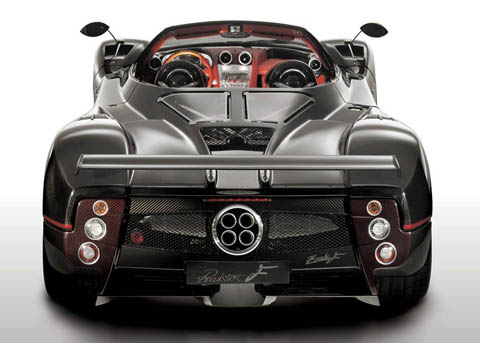
5. Pagani Zonda C12 F $667,321. Produced by a small independent company in Italy, the Pagani Zonda C12 F is the 5th fastest car in the world. It promises to delivery a top speed of 215 mph+ and it can reach 0-60 in 3.5 seconds.
source: http://www.thesupercars.org/top-cars/most-expensive-cars-in-the-world-top-10-list-2007-2008/
GEA (Gulirkan Energi Alternatif), is a continuation of the rollover Alternative Energy. This car is a national car project, and manufactured by PT. Industri Kerata Api (Railway Industry). In this project Vordava task to work as a designer car. Vordava commissioned by the GEA team to change the old face of this car to be much better than before.
PT. Texmaco Perkasa
PT. Texmaco Perkasa is the only truck producer in Indonesia. This truck called "Perkasa" has widely used in Indonesian army due to its strong body and structure.
Marlip
CV. Marlip Indo Mandiri is the only company committed to produce electric car in Indonesia. Its products has reach world wide costumers. Marlip city car is the answer of this company to a healthy and safely car.
Super Gasindo Jaya (SGJ)
PT Super Gasindo Jaya (SGJ)is the only Indonesian company to produce CNG fueled car. Being environmentally friendly, the car also provide high mobility and an alternative for regional government to replace the old and noisy three wheeler.
arina
PT Wahana Cipta is the producer of Indonesia's ciy car that will be the cheapest car in Indonesia with only 30 million per unit. The city car called Arina. Its release, inspired Indonesian to be more confident on the ability of the nation to build its own pride car.
Bukaka Teknik Utama
PT Bukaka Teknik Utama’s main activities cover the engineering and manufacturing of infra-structure related products and services. The company also producing some automotive product related to road construction, fire truck and so on.
Description
thus is a 1955 Studebaker Commander 2Dr in good conditioin, runs good, 259 V8, with 3 spd with overdrive, original engine, interior in good shape. yellow with yellow and black interior, there are no major problems with this car, driven regularly.
Details
Make :studebaker
Model :commander
Year :1955
Daihatsu Taft is a four-wheel-drive vehicle built by Daihatsu between 1974-1984. It was also known as the Daihatsu Scat in some markets. The Daihatsu Taft is similar to Suzuki Jimny and was later replaced by the Daihatsu Fourtrak.
The first Taft was the F10 introduced in 1974. It was equipped with a 1.0L petrol engine and a 4-speed transmission with a 2-range transfer case. The F10 was available in short-wheel-base (SWB) softtop and hardtop versions.
1979 Daihatsu F50
Daihatsu Taft F50 Off Road Prepared
In around 1977, the F10 was replaced with the F20 series with the 1.6L 12R petrol engine. Around the same time the F50 2.5L DG diesel version was introduced. Both models featured an improved transmission and were available in SWB Softtop and Hardtop versions. In 1979, trayback/ute versions of the F20 and F50 introduced as the F25 and F55 models. Around 1983, updated F20/F25 models were introduced with an optional Deluxe version and optional 5-speed gearbox. At the same time the F50/F55 models where replaced with the F60/F65 with a 2.8L DL diesel, with the same Deluxe model version and optional 5-speed gearbox.
Between 1981 and 1984, Toyota sold a rebadged Taft known as the Toyota Blizzard. Fitted with the 2.2L L-series diesel, the LD10 Blizzard featured the same optional Deluxe model fitout as the Taft.
In 1984, the Taft\Scat models were replaced with the Daihatsu Fourtrak (Daihatsu Rocky in Australia). In Indonesia, the Daihatsu Fourtrak is still known as the Daihatsu Taft GT.
Adhering to Honda's typical five-year generational life cycle, the Accord was fully redesigned for 2008. As expected, thise incredibly popular car got larger, roomier and more powerful. Honda worked a little magic here too, as these improvements all came without any penalty in fuel economy, as the numbers were either equal or higher than equivalent precursors. This time, Honda went a bit more aggressive with the styling, with the sedan borrowing a few design cues (notably the sharply creased character line running the length of the car) from the previous Acura TL. The new Accord coupe was more daring, with its sleek look giving it the presence of a more upscale sport coupe.
the interior
The most significant changes were under the car's skinsheet metal. A pair of inline fours and a new V6 promised both better performance and increased fuel economy. A 2.4-liter inline four with 177 hp powereds the LX trims, while a more powerful version cranking out 190 hp was used in the EX. A 3.5-liter V6 boasting 268 hp was available for the EX trims. Transmission choices consisted of a five-speed manual or five-speed automatic for the fours while the V6 could be had with either a five-speed automatic or, on the coupe, a six-speed manual. By using cylinder-deactivation technology, the V6 could run on as little as three cylinders under light-load conditions (such as cruising on a level highway).
The 2009 Accord carried over unchanged except for the V6's stated output moving up a touch due to further testing that revealed greater output than originally figured. The latter means the V6 was now rated at 271 hp.
Porsche 911 classic (1963–1989)
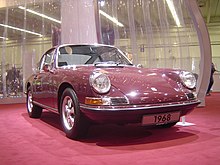
Porsche 911 of 1968
The 911 can trace its roots back to sketches drawn by Ferdinand "Butzi" Porsche in 1959.[4] The Porsche 911 classic was developed as a much more powerful, larger, more comfortable replacement for the Porsche 356, the company's first model. The new car made its public debut at the 1963[1] Frankfurt Motor Show (German: Internationale Automobil-Ausstellung).[5] The car presented at the auto show had a non-operational mockup of the 901 engine, receiving a working one in February 1964.[4]
It originally was designated as the "Porsche 901" (901 being its internal project number). 82 cars were built as 901s.[4] However, Peugeot protested on the grounds that in France it had exclusive rights to car names formed by three numbers with a zero in the middle. So, instead of selling the new model with another name in France, Porsche changed the name to 911. Internally, the car's part numbers carried on the prefix 901 for years.[4] Production began in September 1964[5], the first 911s reached the US in February 1965 with a price tag of US$6,500.[4]
Porsche 911E with Fuchs wheels, 1969
The earliest edition of the 911 had a 130 PS (96 kW; 128 hp)[1] flat-6 engine, in the "boxer" configuration like the 356, air-cooled and rear-mounted, displaced 1991 cc compared with the 356's four-cylinder, 1600 cc unit. The car had four seats although the rear seats were very small, thus the car is usually called a 2+2 rather than a four-seater (the 356 was also a 2+2). It was mated to a four or five-speed manual "Type 901" transmission. The styling was largely by Ferdinand "Butzi" Porsche, son of Ferdinand "Ferry" Porsche. Erwin Komenda, the leader of the Porsche car body construction department, was also involved in the design.
The 356 came to the end of its production life in 1965, but there was still a market for a 4-cylinder car, particularly in the USA. The Porsche 912, introduced the same year, served as a direct replacement, offering the 356's 4-cylinder, 1600 cc, 90 hp (67 kW) engine inside the 911 bodywork.
In 1966 Porsche introduced the more powerful 911S, the engine's power raised to 160 PS (118 kW; 158 hp). Alloy wheels from Fuchs, in a distinctive 5-leaf design, were offered for the first time. In motorsport at the same time, installed in the mid-engined Porsche 904 and Porsche 906, the engine was developed to 210 PS (154 kW).
In 1967 the Targa (meaning "shield" in Italian[6]) version was introduced as a "stop gap" model. The Targa had a stainless steel-clad roll bar, as Porsche had, at one point, thought that the NHTSA would outlaw fully open convertibles in the US, an important market for the 911. The name "Targa" came from the Targa Florio sports car road race in Sicily, Italy in which Porsche had notable success, with seven victories since 1956, and four more to come until 1973. This last win in the subsequently discontinued event is especially notable as it was scored with a 911 Carrera RS against prototypes entered by Italian factories of Ferrari and Alfa Romeo. The road going Targa was equipped with a removable roof panel and a removable plastic rear window (although a fixed glass version was offered alongside from 1968).
The 110 PS (81 kW; 108 hp) 911T was also launched in 1967 and effectively replaced the 912. The staple 130 PS (96 kW; 128 hp) model was renamed the 911L. The 911R had a very limited production (20 in all), as this was a lightweight racing version with thin aluminium doors, a magnesium crankcase, twin-spark cylinder heads, and a power output of 210 PS (154 kW).
In 1969 the B series was introduced: the wheelbase for all 911 and 912 models was increased from 2211 to 2268 mm (87 to 89¼ in), an effective remedy to the car's nervous handling at the limit. The overall length of the car did not change: rather, the rear wheels were relocated aft. Fuel injection arrived for the 911S and for a new middle model, 911E. A semi-automatic Sportomatic[7] model, composed of a torque converter, an automatic clutch, and the four speed transmission, was added to the product lineup. It was canceled after the 1980 model year[8] partly because of the elimination of a forward gear to make it a three-speed.[8]
The 2.2 L 911E was called "The secret weapon from Zuffenhausen"[citation needed]. Despite the lower power output of the 911E (155 PS (114 kW; 153 hp)) compared to the 911S (180 PS (132 kW; 178 hp)) the 911E was quicker in acceleration up to 160 km/h (100 mph).
The 1972–1973 model years consisted of the same models, but with a new, larger 2341 cc (142 in³) engine. This is universally known as the "2.4 L" engine, despite its displacement being closer to 2.3 litres. The 911E and 911S used mechanical fuel injection (MFI) in all markets. For 1972 the 911T was carbureted, except in the U.S. and some Asian markets where emission regulations forced Porsche to equip the 911T with mechanical fuel injection. In January, 1973, US 911Ts were switched to the new K-Jetronic CIS (Continuous Fuel Injection) system from Bosch.
With the power and torque increases, the 2.4 L cars also got a newer, stronger transmission, identified by its Porsche type number 915. Derived from the transmission in the Porsche 908 race car, the 915 did away with the 901/911 transmission's "dog-leg" style first gear arrangement, opting for a traditional H pattern with first gear up to the left, second gear underneath first, etc.
911S models also gained a discreet spoiler under the front bumper to improve high-speed stability. With the car's weighing only 1050 kg (2315 lb), these are often regarded as the best classic mainstream 911s. For racing at this time, the 911 ST was produced in limited numbers (the production run for the ST only lasted from 1970 to 1971). The cars were available with engines of either 2466 cc or 2492 cc, producing 270 PS (199 kW; 266 hp) at 8000 rpm. Weight was down to 960 kg (2166 lb). The cars had success at the Daytona 6 Hours, the Sebring 12 Hours, the 1000 km Nürburgring and the Targa Florio.
source: http://en.wikipedia.org/wiki/Porsche_911